
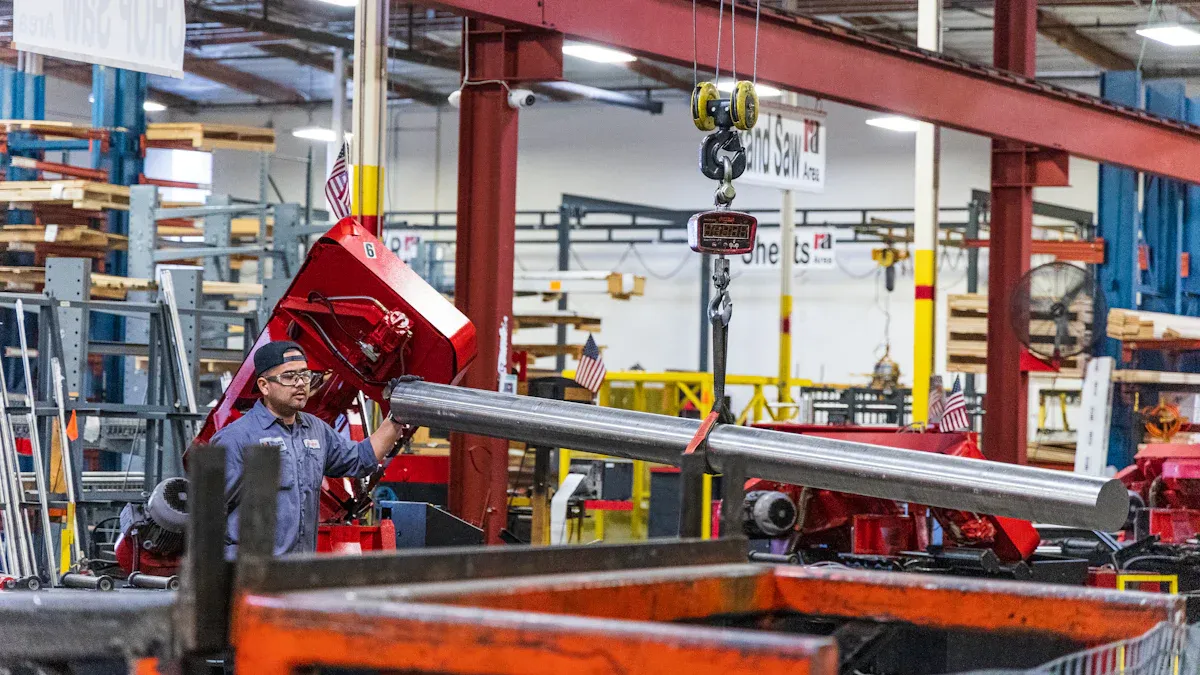
Custom cast aluminum parts significantly enhance operational efficiency and product quality. You can customize these solutions to meet your specific business needs, resulting in improved performance. The global reach of cast aluminum supports clients across various industries, including automobile and telecommunication, ensuring they receive tailored support.
Key Takeaways
- Custom cast aluminum parts enhance durability and strength, lasting 15 to 20 years with proper care.
- Using custom cast aluminum can reduce weight by up to 30%, improving fuel efficiency and performance in vehicles.
- The design flexibility of custom cast aluminum allows for intricate shapes and high dimensional accuracy, making it suitable for various industries.
Benefits of Custom Cast Aluminum

Durability and Strength
Custom cast aluminum parts stand out for their impressive durability and strength. You can rely on these components in demanding environments, as they typically last between 15 to 20 years with proper maintenance. This longevity stems from the material’s ability to withstand various stresses and strains. Cast aluminum offers a good strength-to-weight ratio, making it suitable for applications where both durability and weight considerations are critical.
- Key advantages include:
- Lightweight yet strong, ideal for various applications.
- Capable of forming complex shapes that other materials struggle to achieve.
- Excellent performance for everyday applications, even if not as strong as forged aluminum.
Weight Savings
One of the most significant benefits of using custom cast aluminum is the substantial weight savings it provides. In industries like aerospace and automotive, reducing weight can lead to improved fuel efficiency and performance. For instance, engineering studies have shown that projects utilizing aluminum components achieved weight reductions of up to 30%.
- Consider these points:
- Aluminum is about one-third the weight of steel, which translates to energy savings during vehicle acceleration and maintenance of speed.
- Lighter vehicles can transport heavier loads or accommodate more cargo, enhancing overall efficiency.
- Reducing the load on the engine improves acceleration and enhances fuel efficiency by requiring less energy to transport goods.
Design Flexibility
The design flexibility of custom cast aluminum is another compelling reason to consider it for your projects. The casting process allows for intricate designs and complex geometries that standard manufacturing methods cannot achieve. This capability gives you the creative freedom to produce parts that are not only functional but also visually appealing.
- Benefits of design flexibility include:
- Ability to create complex shapes and intricate details.
- Custom cast aluminum parts can accommodate unique product geometries, making them suitable for various sectors, including aerospace, automotive, and consumer goods.
- The manufacturing process supports high dimensional accuracy, reducing labor costs associated with producing complex shapes.
By leveraging the benefits of custom cast aluminum, you can enhance your product offerings and operational efficiency.
Tailored Solutions for International Clients
When you seek custom cast aluminum solutions, understanding your unique requirements is crucial. Tailored solutions allow you to optimize your products for specific applications, ensuring they meet your operational needs.
Customization Options
International clients often request various customization options for their cast aluminum parts. These options enable you to achieve the precise specifications necessary for your projects. Common requests include:
- Molds tailored to specific designs
- Customized shapes
- Customized sizes
- Customized features
By offering these options, manufacturers can help you create components that fit seamlessly into your existing systems and processes.
Logistics and Compliance
Shipping custom cast aluminum parts internationally presents logistical challenges. However, manufacturers implement effective strategies to address these issues. Here’s a look at some common challenges and their solutions:
| Logistical Challenge | Solution |
|---|---|
| Fragility of aluminum castings | Custom-fit EVA foam linings absorb impact better than basic bubble wrap. |
| Handling during transit | Multi-layer wooden crates with internal dividers prevent parts from shifting. |
| Environmental factors (moisture, humidity) | Kraft paper and vacuum-sealed bags prevent oxidation on anodized or painted surfaces. |
| Risk of damage from mishandling | High-visibility labels in multiple languages reduce mishandling. |
| Damage from lateral pressure or impact | Protective silicone caps or 3D-printed covers guard critical features from damage. |
Additionally, compliance with international regulations is essential. You must be aware of the specific regulations governing the export of custom cast aluminum parts. Here are some key regulations to consider:
| Regulation | Description |
|---|---|
| Section 232 | Tariffs on aluminum products when exporting to the U.S. |
| Proclamation 9704 | Adjusts imports of aluminum into the U.S. |
| Proclamation 9980 | Adjusts imports of derivative aluminum articles into the U.S. |
Meeting International Standards
To ensure your custom cast aluminum parts meet global quality and safety standards, manufacturers adhere to various international standards. These standards help maintain product integrity and reliability. Key standards include:
| Standard | Description |
|---|---|
| ISO 9001 | Ensures standardized, documented quality systems. |
| Internal CMM Inspection | Measures dimensions with high precision, catching defects early. |
| DFM Support | Helps you optimize your design for casting, reducing risk and waste. |
| Material Traceability | Ensures every part can be traced back to its batch and process. |
| Comprehensive Testing | X-ray, spectrometer, and leak testing catch invisible flaws. |
Manufacturers also implement rigorous quality control processes to ensure consistency. This includes material testing, dimensional inspections, and performance evaluations. By following these practices, you can trust that your custom cast aluminum parts will meet the highest standards.
The Process of Ordering Custom Cast Aluminum Parts

Ordering custom cast aluminum parts involves several key steps that ensure you receive high-quality components tailored to your specifications.
Initial Consultation and Design
The initial consultation sets the foundation for your project. During this phase, you collaborate with engineers to discuss your design requirements. Here are the typical steps involved:
- Design: Present your blueprints or files, focusing on the part’s function, appearance, and intended environment.
- Prototyping: Create multiple iterations of the design to refine and improve it.
- Manufacturing Method Selection: Choose the most suitable manufacturing method, which may require adjustments to the design for efficient manufacturability.
To achieve optimal outcomes, engage early in discussions and share detailed information about your requirements and batch sizes. Clear and transparent communication fosters a productive relationship with your manufacturer.
Prototyping and Testing
Prototyping and testing are crucial phases that validate your designs before full-scale production. Various methods are available, each with its advantages and disadvantages:
| Prototyping Method | Advantages | Disadvantages |
|---|---|---|
| CNC Machining | High accuracy, complex geometries, minimal material wastage | Limited strength, expensive for large parts, requires post-processing |
| 3D Printing | Allows complex designs, rapid prototyping, minimal material wastage | Limited strength, expensive for large parts, requires post-processing |
| Die Casting | High production rate, excellent dimensional accuracy | High initial tooling cost, limited to high-volume production |
| Investment Casting | Excellent surface finish, capable of complex shapes | High cost of molds, labor-intensive, not suitable for large parts |
| Sand Casting | Low tooling cost, suitable for large parts | Rougher surface finish, lower dimensional accuracy, slower production |
Thorough prototyping helps identify design flaws early, preventing costly mistakes later. The complexity of your design and materials used can significantly impact overall project costs.
Production and Delivery Timelines
Understanding production and delivery timelines is essential for planning. Here are some average lead times based on industry benchmarks:
- Tooling lead time: 2-4 weeks
- Prototype machining: 1 day for simple parts, 3 days for complex parts
- High volume production (1000+ parts): 3-4 weeks
Factors such as part complexity, order volume, and testing requirements can affect lead times. A strong relationship with your supplier can enhance scheduling and planning for future orders.
Case Studies of Custom Cast Aluminum
Successful Implementation in Aerospace
Aerospace companies have reported remarkable improvements after adopting custom cast aluminum solutions. These parts enhance precision and reduce weight, leading to significant cost savings. For instance, manufacturers achieve tolerances of +/- 0.005 inches or better. The following table highlights measurable benefits:
| Improvement Type | Measurable Benefit |
|---|---|
| Precision and Accuracy | Tolerances of +/- 0.005 inches or better |
| Weight Reduction | Parts can be 15 to 25% lighter |
| Cost-Effectiveness | Saves production time by around 50% and money up to 30% |
| Material Waste Minimization | Reduces waste during casting by around 70% |
| Fuel Efficiency | Reduces fuel usage by up to 10% |

Innovations in Automotive Manufacturing
In the automotive sector, custom cast aluminum technologies drive innovation. These advancements lead to lighter vehicles, which improve fuel efficiency and structural integrity. Key innovations include:
- Custom aluminum extrusions and castings reduce vehicle weight.
- New generation alloys enhance strength and heat characteristics.
- Combining conventional casting with 3D printing minimizes waste and improves part design.
Manufacturers quantify these benefits through various metrics. The table below summarizes the advantages of using custom cast aluminum parts:
| Benefit | Description |
|---|---|
| Complex Shapes Made Easily | Enables manufacturers to achieve intricate designs that are difficult with other techniques. |
| Cost-Effective Production | Reduces labor and material costs through reusable molds and automation, ideal for mass production. |
| Material Efficiency | Minimizes raw material waste and allows for recycling, making the process environmentally friendly. |
| High Strength and Durability | Produces stronger components that can withstand significant loads and wear, crucial for safety. |
| Lightweight Design | Utilizes advanced alloys to create lighter parts, enhancing fuel efficiency and vehicle handling. |
| Scalability | Easily transitions from prototype to mass production while maintaining quality and performance. |
Solutions for Consumer Electronics
Custom cast aluminum parts play a vital role in the consumer electronics sector. They enable the production of lightweight and durable components that meet modern demands. Notable applications include:
| Alloy Type | Application in Consumer Electronics |
|---|---|
| 383 | Precision components for smartphones and laptops |
| B390 | Casings for smartphones, tablets, and laptops |
| A380 | Intricate parts like smartphone housings |
| A360 | High-precision components like smartphone casings |
These solutions enhance product innovation, ensuring devices are both functional and aesthetically pleasing. The corrosion resistance and thermal conductivity of aluminum make it ideal for mobile phones and networking hardware.
Custom cast aluminum parts offer numerous advantages that can transform your business operations. You gain flexibility in materials, allowing for a wide range of applications. Tight tolerances ensure high precision in part manufacturing. Faster production times lead to quicker market responses. Investing in custom cast aluminum enhances your competitive edge.
FAQ
What industries benefit from custom cast aluminum?
Custom cast aluminum serves various industries, including aerospace, automotive, and consumer electronics, enhancing product performance and efficiency.
How long does it take to produce custom cast aluminum parts?
Production timelines vary, but tooling typically takes 2-4 weeks, while high-volume production can take 3-4 weeks.
Can I request specific design features for my parts?
Yes, you can request tailored designs, including unique shapes, sizes, and features, to meet your specific project requirements.
Post time: Sep-25-2025