
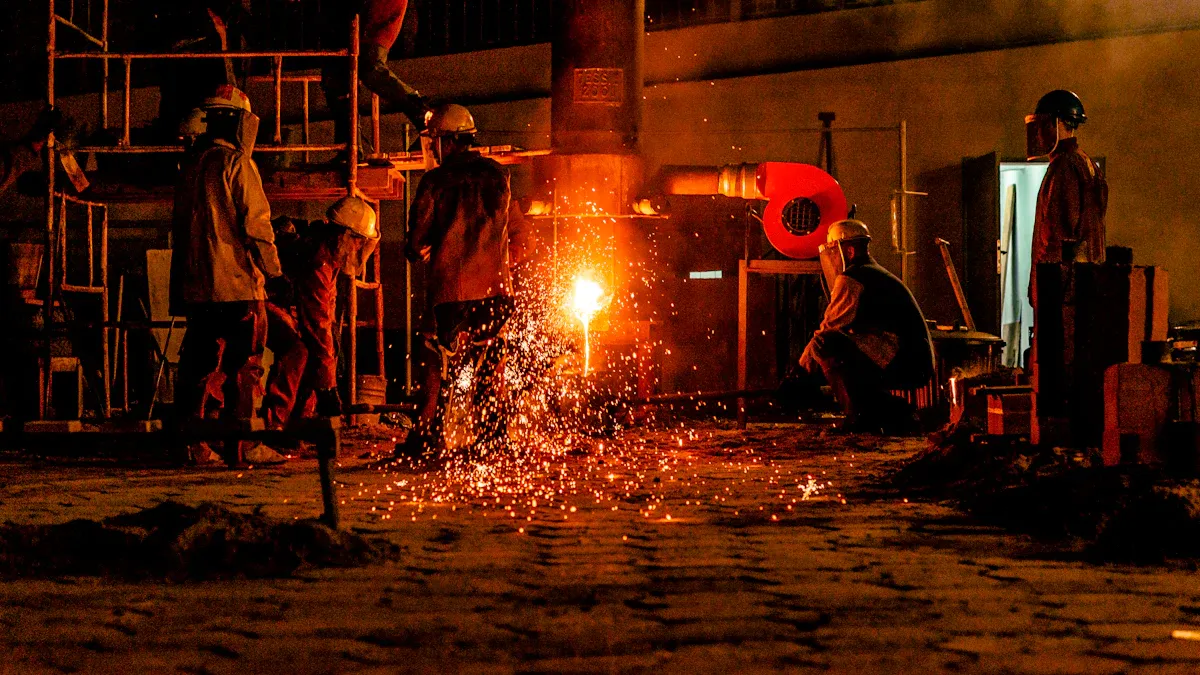
You benefit from recent advances in die casting technology that elevate cast aluminum quality to new heights.
- Components now weigh up to 13% less while keeping excellent surface quality.
- Uniform porosity ensures consistent results.
- Optimized casting parameters deliver reliable parts for Automobile and Telecommunication industries.
Key Takeaways
- High-pressure die casting enhances the strength and surface quality of aluminum parts, making them lighter and more durable.
- Vacuum-assisted casting reduces internal defects, resulting in higher density and better mechanical properties for cast aluminum components.
- Real-time defect detection systems significantly lower scrap rates, ensuring higher quality and more reliable aluminum parts.
Key Innovations Transforming Cast Aluminum Die Casting
High-Pressure Die Casting
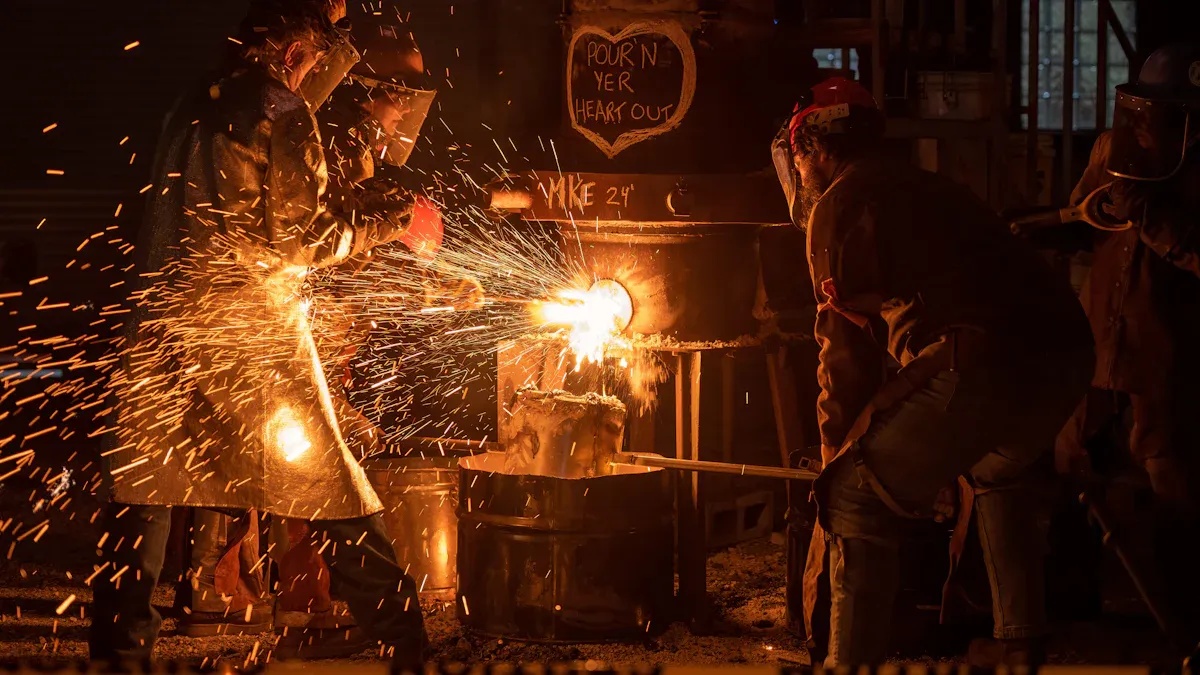
You see major improvements in cast aluminum quality thanks to high-pressure die casting. This process injects molten metal into the die at high speed, filling even the most complex shapes. You benefit from reduced porosity and stronger parts. The rapid solidification creates a refined microstructure, which boosts mechanical properties. You also notice smoother surfaces and better dimensional accuracy, making your components fit perfectly every time.
- Enhanced filling of complex shapes
- Reduced porosity for stronger parts
- Quick solidification for improved mechanical properties
Vacuum-Assisted Casting
Vacuum-assisted casting takes quality a step further. By removing air from the mold cavity, you cut down on gas porosity and trapped gases. This method helps the metal flow better, filling intricate designs with ease. The result is cast aluminum with fewer internal defects and higher density.
| Key Point | Description |
|---|---|
| Gas Entrapment | Vacuum systems remove air, reducing gas porosity. |
| Metal Flow | Improved flow fills complex shapes more effectively. |
| Mechanical Props. | Higher density and better tensile strength for durable cast aluminum parts. |
Real-Time Defect Detection
You can now rely on real-time defect detection systems to catch flaws before they become costly problems. Deep learning and X-ray imaging spot internal and surface defects with high accuracy. These systems help you lower scrap rates and save money. For example, one automotive manufacturer reduced defect rates from 8% to 1.5% after using AI visual inspection, saving $300,000 annually.
Tip: Real-time monitoring means you deliver higher quality cast aluminum parts with less waste.
Advanced Aluminum Alloys
You have access to advanced aluminum alloys that outperform older materials. Alloys like A380, A383, and B390 offer better castability, wear resistance, and dimensional stability. These new alloys help you produce cast aluminum components that last longer and perform better in demanding environments.
| Alloy | Key Features |
|---|---|
| A380 | Excellent castability, good mechanical properties, corrosion resistance |
| A383 | Improved fluidity, reduced shrinkage porosity |
| B390 | High wear resistance, dimensional stability |
How Technology Improves Cast Aluminum Quality
Enhanced Dimensional Accuracy
You achieve precise dimensions in cast aluminum components by using high-pressure injection and advanced mold designs. Modern die casting methods fill molds quickly and completely, which ensures that each part matches exact specifications. Unlike older techniques, these processes maintain tighter tolerances and reduce the need for extra machining. You benefit from consistent results, even when producing complex shapes at high volumes.
- High injection speed fills molds completely.
- Intensification pressure meets strict dimensional tolerances.
- Short casting cycles support mass production.
Modern die casting delivers parts that fit perfectly, which is essential for industries like automotive and electronics. You can rely on these methods to produce cast aluminum parts that meet demanding standards every time.
Reduced Porosity and Defects
You minimize porosity and defects in cast aluminum by controlling air pressure and optimizing casting parameters. Vacuum-assisted die casting removes trapped gases, which leads to denser and stronger parts. You also see improvements when you apply pressure during solidification and maintain optimal die temperatures.
| Study | Findings | Conclusion |
|---|---|---|
| Zhang et al. | Compared HPDC and gravity die-cast samples of AlSi7MnMg alloy. | Shrinkage porosity is more detrimental than entrapped gas. |
| Yu et al. | Focused on defect morphology and microstructure in magnesium HPDC. | Mechanical properties depend on defect band width. |
| Another group | Used X-ray CT to characterize magnesium alloys. | Correlation between critical section porosity and elongation. |
You improve quality by standardizing processes, monitoring production, and maintaining equipment. These steps help you detect and fix issues early, which results in fewer defects and higher reliability for cast aluminum components.
Superior Mechanical Properties
You gain stronger and more durable cast aluminum parts by using advanced alloys and optimized casting techniques. High-pressure die casting creates fine grain structures and uniform microstructures, which boost yield strength, tensile strength, and ductility.
| Property | Value |
|---|---|
| Yield Strength | 212 MPa |
| Ultimate Tensile Strength | 357 MPa |
| Elongation | 17.6% |
The formation of externally solidified crystals during casting influences stress distribution and mechanical performance. You notice that skin regions with fine grains enhance surface strength, while central regions with bimodal grain structures improve overall durability. These improvements make cast aluminum ideal for demanding applications where strength and reliability matter.
Consistent Surface Finish
You achieve a smooth and uniform surface finish on cast aluminum parts by using high-pressure injection and permanent steel molds. This process reduces the need for post-machining and ensures that each component looks and performs consistently.
| Aspect | Impact |
|---|---|
| Fatigue Life | Each doubling of Ra can reduce fatigue strength by ~5–10%. |
| Wear Resistance | Smoother surfaces (Ra < 0.4 µm) minimize abrasive wear. |
| Stress Concentration | Rough surfaces create micro-notches that concentrate stress. |
| Corrosion Under Crevices | Smoother surfaces reduce localized corrosion risks. |
| Coating Adhesion | Controlled roughness is necessary for effective coating adhesion. |
You benefit from improved fatigue life, better wear resistance, and reduced risk of corrosion. Consistent surface finish also helps coatings adhere more effectively, which extends the lifespan of cast aluminum components in harsh environments.
Cast Aluminum Applications and Industry Impact
Automotive Sector
You see the automotive industry transform with advanced die casting technology. Modern vehicles rely on lighter and stronger components to improve efficiency and safety. Aluminum die casting helps you reduce vehicle weight while maintaining strength, which is especially important for electric vehicles. You benefit from compact and durable parts in electric drivetrains, such as motor housings and battery structures. The sector continues to grow as new alloys, casting techniques, and automation shape future vehicle designs.
- Lighter and stronger parts for improved fuel efficiency
- Essential for electric vehicle motor housings and battery cases
- Supports the shift to sustainable materials
| Alloy Composition | Tensile Strength (MPa) | Yield Strength (MPa) |
|---|---|---|
| AlSi9Mg0.2 | 260.88 – 279.39 | 185.01 – 202.48 |
| AlSi9Mg0.3 | 276.0 – 287.27 | 199.11 – 210.0 |
You find these alloys in wheels, brake components, and body structural parts, all benefiting from high-pressure die casting for strength and reliability.
Aerospace Industry
You depend on high-quality aluminum castings for critical aerospace components. These parts must be lightweight, corrosion-resistant, and offer excellent thermal and electrical conductivity. Automation and computer-aided design help you achieve precise and consistent results, which are vital for safety and performance.
- Lightweight materials reduce aircraft weight and improve fuel efficiency
- High strength-to-weight ratio supports demanding aerospace standards
- Precision casting ensures tight tolerances for airframes, wings, and engine parts
You notice that cast aluminum delivers the durability and reliability required for modern aircraft, making it a preferred material in the industry.
Electronics Manufacturing
You rely on cast aluminum for electronic enclosures and housings. These parts protect sensitive components and manage heat effectively. Aluminum alloys provide high tensile strength and durability, which shield electronics from damage. You also benefit from lightweight properties, making assembly and handling easier.
| Benefit | Explanation |
|---|---|
| Enhanced Durability | High tensile strength protects components. |
| Lightweight Properties | Reduces weight for easier assembly. |
| Effective Thermal Management | Excellent heat dissipation for performance. |
| Cost-Effectiveness | Affordable for large-scale production. |
| Recyclability | Supports sustainability goals. |
| Design Flexibility | Enables complex shapes and tight tolerances. |
| Ease of Machining | Simplifies manufacturing and ensures quality. |
You find die cast aluminum in motor housings, LED lighting fixtures, telecommunication enclosures, and PCB enclosures. These products offer superior durability and thermal management compared to plastic alternatives.
Quality Assurance for Cast Aluminum Components
Automated Inspection Systems
You rely on automated inspection systems to ensure every cast aluminum component meets strict quality standards. These systems use machine vision to quickly spot defects like pits and flow lines. Robotic arms equipped with deep learning models, such as YOLOv8 and Mask R-CNN, check for issues like filing errors and hole misalignments.
- Machine vision detects surface imperfections rapidly.
- Robotic systems assess features with high accuracy.
- Deep learning models improve detection of even the smallest flaws.
- Fully automated systems inspect multiple features at once, reducing errors and speeding up production.
Automated inspection systems outperform manual checks. They identify tiny cracks and surface defects that human eyes might miss. You avoid inconsistencies caused by fatigue or bias, which often affect manual inspections. Integrating deep object detection with X-ray imaging further boosts accuracy and efficiency.
Data-Driven Process Control
You achieve consistent quality by using data-driven process control. Advanced automation reduces human error, while real-time data acquisition ensures each casting meets your standards. Simulation tools help you optimize the process, saving time and resources.
| Analysis Type | Findings |
|---|---|
| Parameter Control | Data visualization identifies critical parameters and sets control limits. |
| Confidence Interval | Production data defines upper and lower limits for zero rejection rates. |
Quality prediction systems let you catch defects early. Real-time monitoring provides instant feedback, so you can adjust processes immediately. Machine learning models predict quality based on casting conditions, improving productivity and cost efficiency.
Traceability and Reporting
You strengthen your quality assurance with robust traceability and reporting systems. These tools let you track each component’s journey through production. You quickly identify and isolate affected lots, improving safety and compliance.
| Benefit | Description |
|---|---|
| Improve safety | Locate affected lots fast to protect users. |
| Track better data | Access real-time routing and processing information. |
| Identify problems faster | Spot machine or material issues before they escalate. |
| Protect your reputation | Minimize recalls and maintain customer trust. |
| Increase speed | Respond quickly to factory issues. |
| Stay compliant | Simplify audits and meet regulations. |
| Prevent errors | Catch defects early and keep them off the market. |
| Improve your business | Analyze processes for better root-cause solutions. |
Tip: Strong traceability not only ensures quality but also builds trust with your customers.
You set new standards for cast aluminum quality with advanced die casting technology. Manufacturers see higher reliability and less waste. End-users enjoy safer, longer-lasting parts.
| Benefit | Description |
|---|---|
| Strength-to-weight ratio | Cast aluminum is 66% lighter than steel, boosting fuel efficiency. |
| Cost advantages | Lower tooling costs and faster production cycles. |
| Mechanical properties | Heat treatment increases strength and durability. |
FAQ
What advantages do you gain from high-pressure die casting?
You achieve precise shapes, strong parts, and smooth surfaces. This process helps you reduce defects and improve the overall quality of your aluminum components.
How does real-time defect detection benefit your production?
You spot flaws instantly during casting. This lets you fix problems early, lower scrap rates, and deliver more reliable aluminum parts to your customers.
Why should you choose advanced aluminum alloys for die casting?
You get better strength, improved wear resistance, and longer-lasting parts. These alloys help you meet demanding industry standards and boost your product’s performance.
Post time: Sep-01-2025